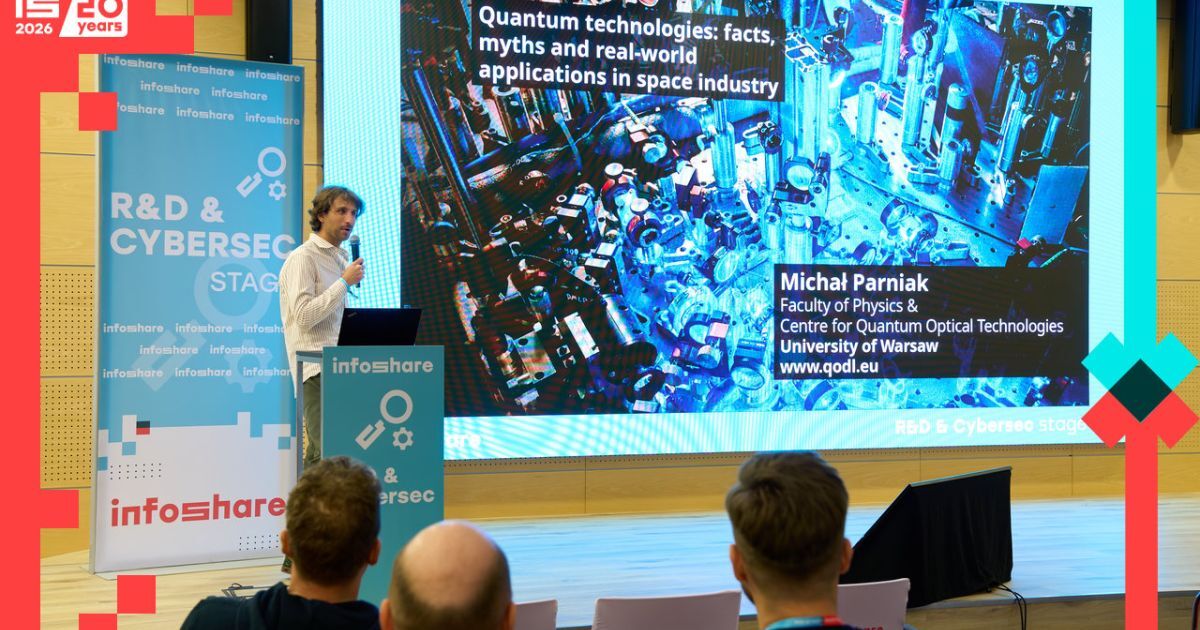

Quantum technologies: facts, myths and real-world applications in space industry
11:45 - 12:15, 21st of May (Thursday) 2026 / R&D & Cybersec
The quantum landscape sits between scientific revolution and industry hype. While the "quantum bubble" has inflated computing expectations, the reality is a diverse ecosystem of sensing, metrology, and communication requiring deep research. The rising Rydberg platform illustrates that quantum effects offer more than just data processing; they provide a tangible path for atomic physics to solve real-world hardware challenges.
This shift is epitomized by the Rydberg antenna. Our team is developing room-temperature sensors that use lasers to excite rubidium electrons into "giant" orbits, creating ultra-sensitive atomic states. A single millimeter-sized cell can detect electromagnetic waves from megahertz to terahertz without traditional electronics. Being purely atomic, this "universal" receiver is non-intrusive and inherently resilient against jamming or electronic overload.
Supported by the European Space Agency, this breakthrough offers massive size and weight savings for satellites. Its precision is vital for spectrum analytics, 6G, and future quantum-network hardware. By moving from the lab to the space sector, these sensors prove the most immediate value of the quantum era lies in the hardware that secures and connects our global infrastructure.